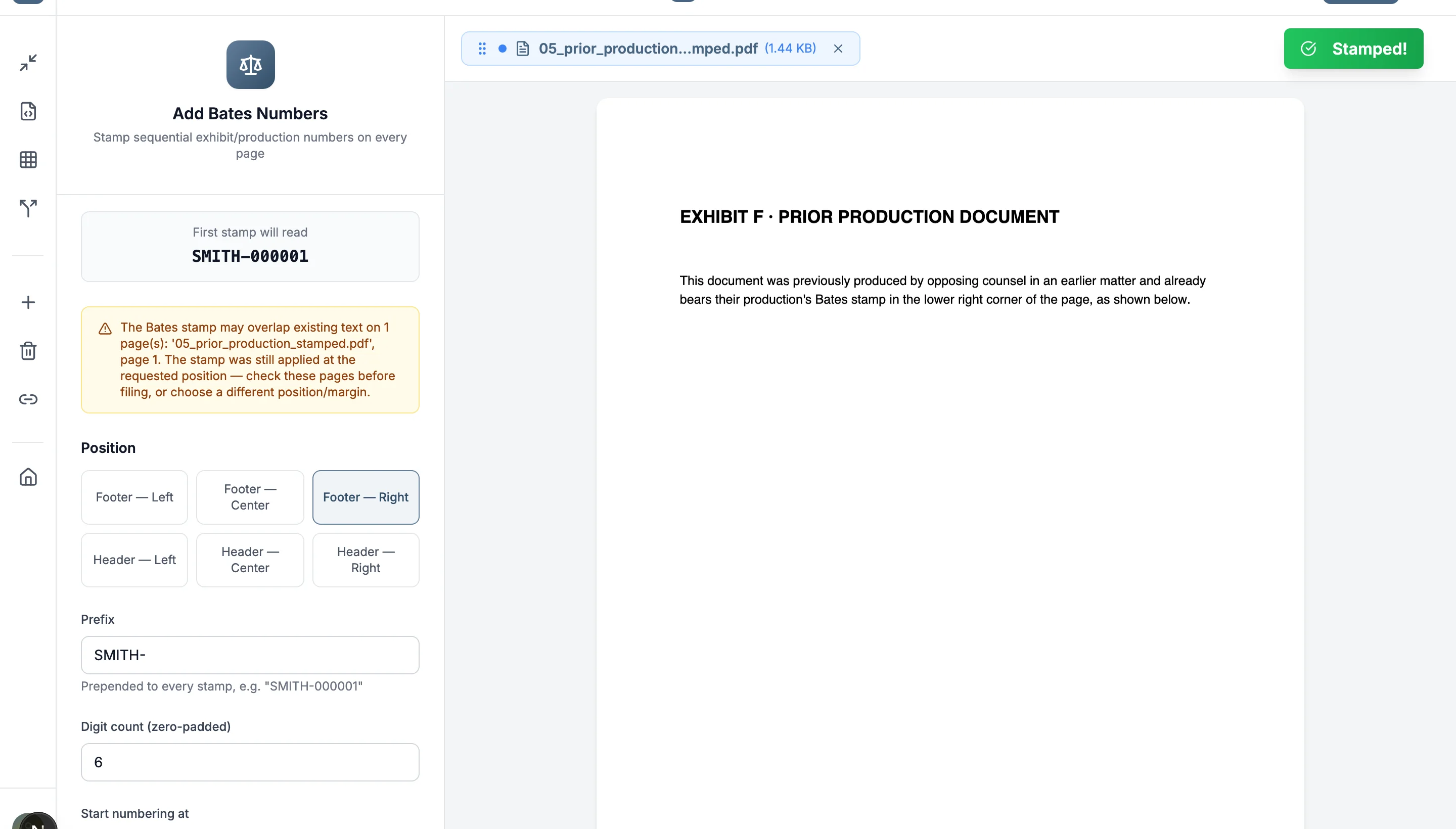
Re-stamping a document that already has a production number on it? PDFCourt checks for overlap and warns you — most Bates tools stamp blind and let the numbers collide.
Everything you need to work with PDFs, all in one place
1 tools
7 tools
11 tools
5 tools
4 tools
Bates stamp PDFs online free — numbering continues from file to file, a custom prefix, zero-padded digits. Skip the $20/month Acrobat subscription — files are encrypted at rest and in transit, then auto-deleted.
or drag and drop your files hereTap to browse from your device
Select or drag and drop every file in the production, in the order you want them numbered.
Choose a prefix, digit count, and starting number — numbering continues across every file you uploaded.
Get every file back with sequential Bates numbers stamped on every page, ready to produce.
Re-stamping a document that already has a production number on it? PDFCourt checks for overlap and warns you — most Bates tools stamp blind and let the numbers collide.
Number an entire exhibit production in seconds
Drag and drop or select every file in the production
Prefix, digit count, position, and continuous numbering
Get every file back, stamped and ready to produce
Number document productions for discovery
Number trial or deposition exhibits
Keep numbering continuous across 100s of files
Track and cite pages across amendments
Your documents are protected by industry-leading security measures
Encrypted at rest and in transit
Never retained — deleted after your session
Handled per EU data protection rules
HTTPS/TLS on every upload
Only automated systems touch your file
Enterprise-grade infrastructure
Use without signup
Built for confidential documents
Handle confidential documents with AES-256 encryption at rest and in transit, automatic deletion, and no third-party file review.
Free, unlimited, no registration required
Merge, Bates number, and auto-link an index — in one step
The full e-filing prep checklist — Bates numbering, redaction, PDF/A, and more
Stamp sequential page numbers in any position
Permanently remove sensitive text or images — not just cover them
Everything you need to know about Bates numbering
Bates numbering is a unique, sequential number stamped on every page of every document in a legal production (e.g. SMITH-000001), used to identify and cite exhibits and discovery materials. It's named for the 1891 Bates Automatic Numbering Machine.
No — standard practice is one continuous, unbroken sequence across the entire set of files (file one ends at 000042, file two starts at 000043). This tool does that by default. You can turn off continuous numbering to restart each file at your chosen start number instead.
Yes — the prefix (often a party name or case number) is standard practice for identifying the producing party, e.g. 'SMITH-000001'. Enter any prefix up to 40 characters.
Six digits (000001) is the de facto standard for most productions. Five digits is fine for smaller sets; seven or eight digits suit very large productions (100,000+ pages). This tool supports 1 to 12 digits.
Bottom-right is the near-universal convention — it stays out of the way of headers and page numbers. Some parties or jurisdictions specify a different position by agreement, so this tool lets you choose any header or footer position.
Federal (FRCP 26/34) and most state discovery rules require productions to be identifiable, but don't mandate a specific numbering format — Bates numbering is simply the universally recognized way courts and opposing counsel expect that requirement to be met.
No. Acrobat Pro (~$20/month) is the tool most people assume they need, but it's not the only option — this tool applies the same permanent, embedded stamp for free, directly in your browser.
Bates numbers identify individual pages across an entire production. Exhibit numbers (Exhibit 1, Exhibit A) identify whole documents at trial — a trial exhibit index typically cites both together.
Yes — this tool processes multi-file productions of any realistic size in your browser, with no per-document fee. Very large productions (100,000+ pages) may be more comfortable with 7-8 digit numbering; see the digit-count question above.